Learn About Local Dinosaurs
Dinosaur footprints of the Connecticut River Valley
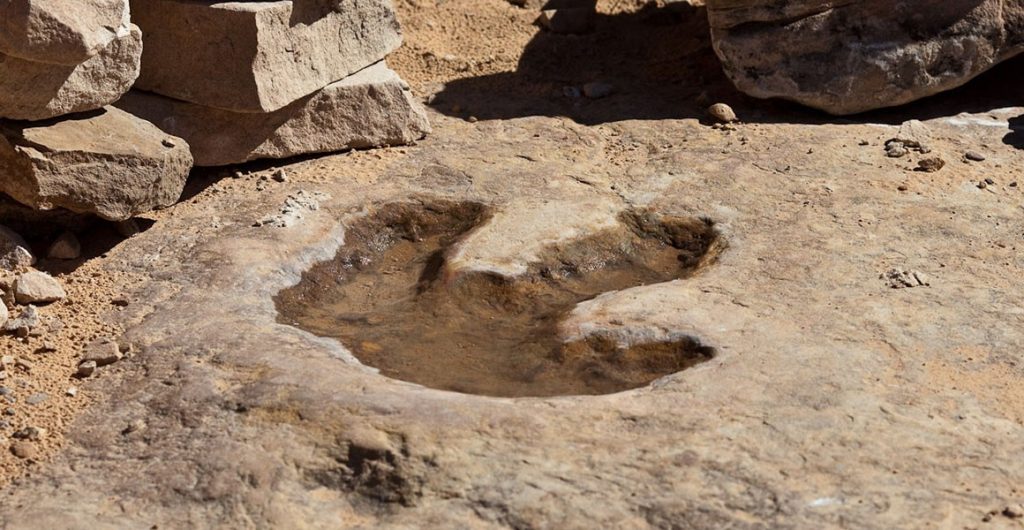
It must be stated at the beginning that dinosaurs have two different naming systems. One system is for the skeletal remains and the other system is for the tracks or trace fossils they left behind. The reason for this is that unless a dinosaur died in its tracks, a scientist can not know for certain which skeleton goes with which tracks. Of the tracks that have been found, it is not even possible to know if the skeleton has yet been found for that particular track.
A. Large Dinosaur Tracks
- Eubrontes (“True Thunder”) track length 10-20 inches:
These tracks were made by a large, bipedal, carnivorous, Theropod dinosaur similar to a Dilophosaurus and are among the most common tracks found in the valley. These dinosaurs probably reached a length of 20 feet .
The animal that made these tracks was one of the first large meat-eating dinosaurs . Scientists studying these tracks have compared the tracks to the foot skeleton of the well-known dinosaur Dilophosaurus . They have noted that the foot skeleton of the Dilophosaurus seems to fit nicely into these footprints . Thus it is likely that an animal similar to the Dilophosaurus made the Eubrontes tracks. Dilophosaurus is best known for its role in Jurassic Park , where it ate the computer expert in the jeep. It’s the valley dinosaur that went to Hollywood and made it big.
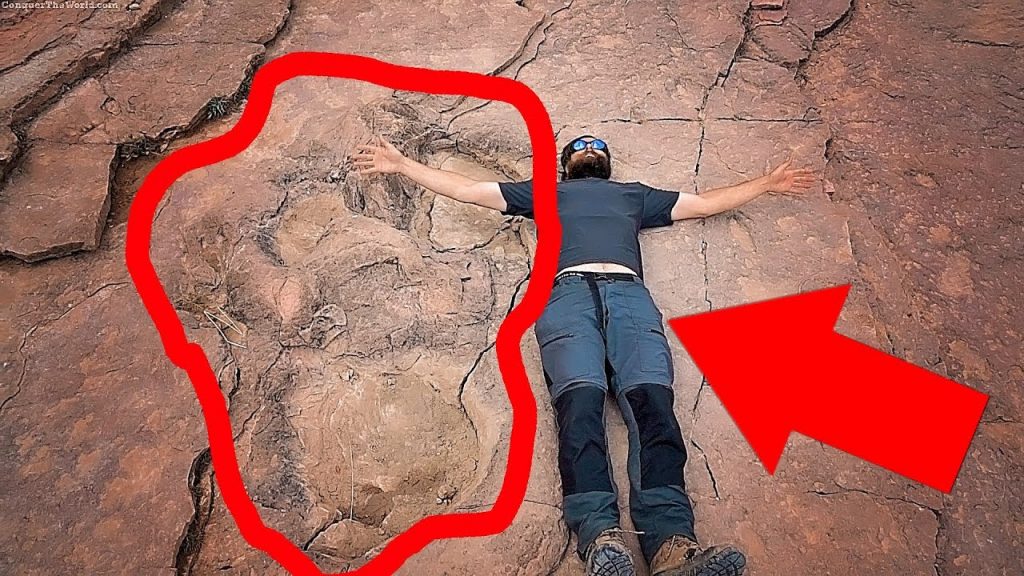
- Gigandipus (“Giant Foot”) track length 10-20 inches:
These tracks were made by large, bipedal, carnivorous, Theropod dinosaur similar to a Dilophosaurus . The Gigandipus track is relatively rare . These dinosaurs probably reached a length of 20 feet.
The distinctive features of these tracks are that they show a tail dragging and the presence of a hallux toe ( The hallux is the first toe. In humans this is the big toe , but in most dinosaurs it was reduced and much smaller than the three weight-bearing toes .)
These tracks are very much like Eubrontes tracks, so much so that many scientists who study these tracks think that they were made by the same large theropod dinosaur. The differences may indicate that there was variability between different animals within the genera .The presence of the hallux toe and a tail dragging suggest to some paleontologists that the dinosaur may have been walking low to the ground – possibly while stalking prey or carrying something in its mouth.
- Otozoum (“Giant Animal”) track length around 10-20 inches:
These tracks were made by large, bipedal, Prosauropod dinosaur similar to the Plateosaurus. It is considered to be an early prosuaropod and the track is quite rare . The dinosaur probably reached a length of 20-30 feet .
Scientists have never found any skeletal material for this dinosaur in the Connecticut River Valley, but it is thought to have been an early plant-eating ancestor of the later sauropod dinosaurs. It can be distinguished from other dinosaur tracks in that it has four, thick, forward-pointing toes while all the other dinosaur tracks in the valley are three-toed. Sometimes the front feet are evident in the walkways so it must have sometimes dropped down and walked on all four legs.
B. Medium-sized Dinosaur Tracks
- Anchisauripus (“Close to Lizard Foot”) track length 7-10 inches:
These tracks were made by a medium-sized, bipedal, carnivorous, Theropod dinosaur similar to a Coelophysis . This dinosaur probably reached a length of 7-10 feet.
Skeletal remains of an animal similar to Coelophysis have been found in the valley supporting the conclusion that it was like a Coelophysis . These tracks could have been made by the adult version of the dinosaur that made the Grallator tracks.
- Grallator (“Stilt Walker”) track length 3-7 inches:
These tracks were made by a small to medium-sized, bipedal, carnivorous, Theropod dinosaur similar to Podokesaurus holyokensis, which was found nearby in South Hadley, Massachusetts. These dinosaurs probably reached a length of 3-7 feet .
These tracks were made by a slightly smaller dinosaur than the one that made the Archisauripus tracks, and may simply be a juvenile of that dinosaur. The stride of their walkways show that they were probably the fastest dinosaurs in the valley. They may have attained speeds of up to 20 miles per hour. This is one of the most common types of dinosaur tracks found in the Connecticut River Valley.
- Anomoepus (“Odd Track”) track length 3-6 inches:
These tracks were made by a small, bipedal, herbivorous, Ornithischian dinosaur similar to a Scutellosaurus that sometimes dropped down onto it’s front two feet so as walk on all four legs. These dinosaurs probably reached a length of 3-6 feet .
The ornithischian dinosaurs are the group of dinosaurs that include the familiar stegosaurs, ankylosaurs, the horned ceratopsians, and the duckbills. Occasionally there is a sign of a tail dragging present in the walkways. Anomoepus was the first type of dinosaur footprint found in the Connecticut River Valley . The first specimens were discovered near the Nash Dinosaur Track Site in 1802 by Pliny Moody, a farmer’s son, as he plowed a field .
C. Small Reptile Tracks
- Batrachopus (“Frog Foot”) track length 1 inch:
Batrachopus dinosaur tracksThese tracks were made by an early crocodilian-like reptile similar to Stegomosuchus longipes . The animals that made these tracks probably reached a length of 2-3 feet.
Like today’s crocodiles, the Batrachopus track maker walked on all four legs, so both their hand and foot impressions are found in the walkways. However, unlike today’s crocodiles, which are aquatic, the Batrachopus animals were fast-running land animals. It wasn’t until later that the crocodile became a dominant aquatic carnivore . The first of these tracks were found in East Longmeadow, Massachusetts